with Grayson Pike
“A great implementation experience! Truly the easiest part of our stack to set up, which is impressive given that it's our financial ledger. Today, if we're thinking about a hundred things that could go wrong, our ledger is not one of them.”

Grayson Pike and Yash Sahota, Co-Founders of TripleZip
TripleZip was founded by lifelong friends Grayson and Yash, who’ve known each other since middle school. They grew up in the same neighborhood in Texas, studied computer science side by side, and spent years turning evenings and weekends into side projects. In 2025, after some post-graduation years spent in corporate jobs, they took a leap to start something of their own, joining Y Combinator’s Winter batch and moving to San Francisco.
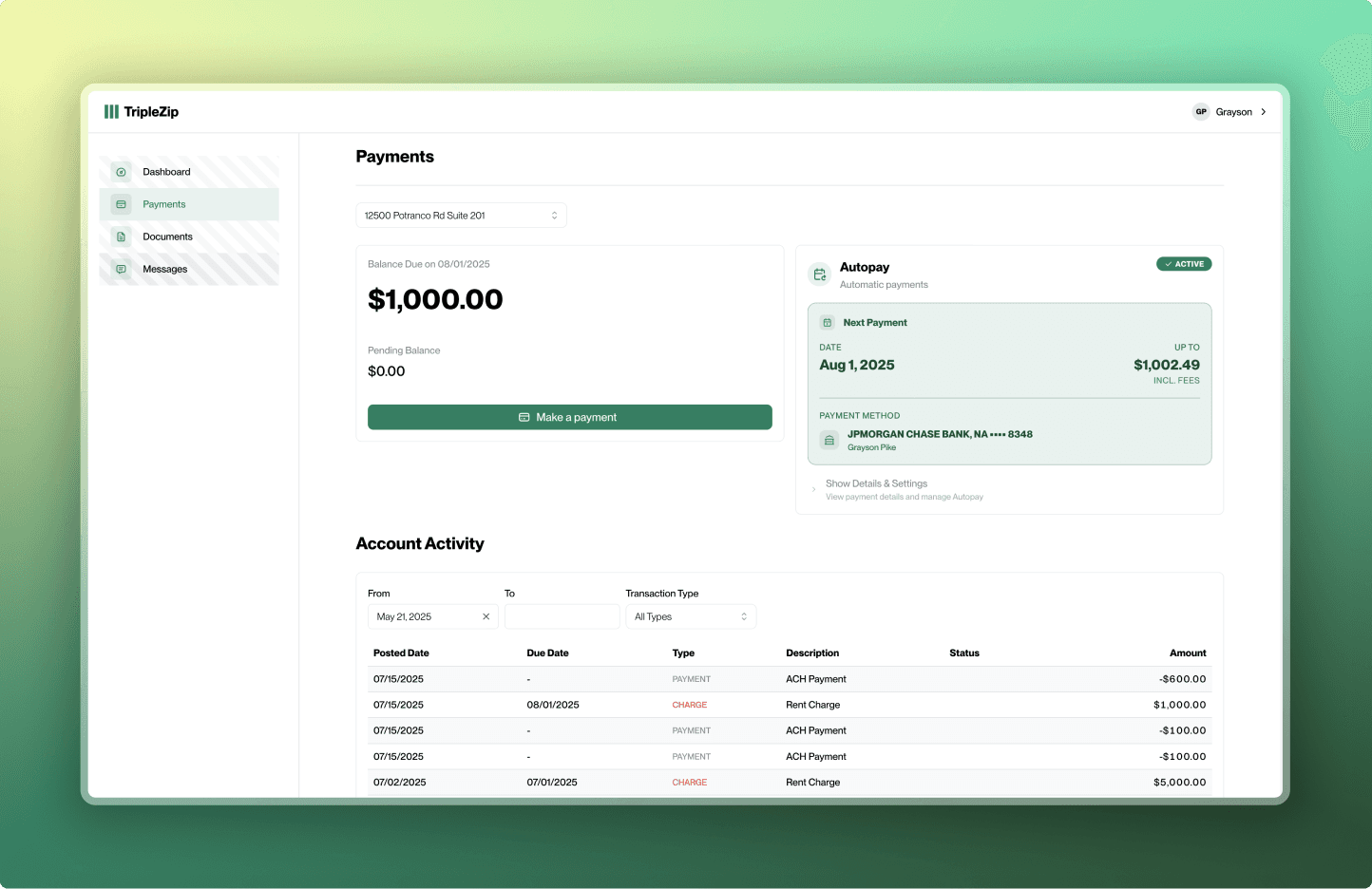
Today, their platform serves the “mom and pop” of commercial real estate in the United States – families who own a small retail center, a single building, or a handful of properties. For these owners, existing software was either too complex (built for billion-dollar portfolios) or non-existent (leaving them juggling spreadsheets and paper checks). TripleZip makes rent collection, accounting, and payments simple for even the smallest landlords.
They discovered TigerBeetle in the search for an online transaction processing (OLTP) solution, were delighted by the extreme engineering, speed of onboarding, and simple implementation, and haven’t looked back.
An Idea Rooted in Family Business
Grayson’s father ran a car repair shop in San Antonio, while Yash’s father built up a convenience-store and gas-station business, both eventually shifting into small-scale property ownership. This meant a front-row seat to how hard it was for small property owners to manage commercial leases without accessible tools.
TripleZip actually entered Y Combinator with a different idea: automating complex annual reconciliations for large institutional landlords. Technically feasible, but commercially tough; convincing billion-dollar firms to trust a young startup with their most sensitive lease data would be a steep hill to climb.
“We began with and actually built a solution that could perform really complex calculations in a mostly automated way, using AI and whatnot, but realized that getting a foot in the door with big enterprises would take more time.”
Midway through the batch, the duo pivoted to solving problems for small landlords. Commercial real estate management software is typically built for large companies with complex financial situations and diverse portfolios, making it expensive and intimidating for small businesses, who end up handling checks and doing everything on paper.
“We wanted to provide an easy solution, where one-or two-person businesses don't have to become super technical or overinvest, but still get the benefits of convenient accounting and can create a modern payment experience for their tenants.”
It was time to start building.
Diving Deep into Debit/Credit
Being engineers by trade, they were able to set up their app relatively quickly, then dipped their toes into the world of double-entry accounting. With neither of them from a financial background, Grayson recalls when the implications and responsibility of handling thousand-dollar payments hit home:
“We'd always worked on non-financial systems. I realized we needed proper double-entry bookkeeping, not a normal database, with accounts, credits, and debits. I was surprised at how little there was out there. It kind of blew me away that the Stack Overflow answers were to read some books and build it yourself in MySQL or Postgres. We needed to build something quickly, it was a new concept to us, and we couldn’t afford to make any mistakes.”
They came across TigerBeetle on an internal YC forum.
“There are many open-source projects that get abandoned after a few years. You can tell when you look at them: static text page and the original author left three years ago. You don't want to base your financial security on that, necessarily.”
TigerBeetle’s website, documentation, and active community gave him confidence. Just to be diligent, Grayson looked around to see if there were any equivalent options, but didn't find anything.
Something they particularly liked: TigerBeetle’s simplicity, performing the core responsibility of taking care of the numbers, and leaving them to build out their abstractions and manage everything else:
Correctness included: Double-entry enforced at the database level.
1000x Performance: Designed to avoid the row-lock bottlenecks they knew they’d face.
Safe engineering: Rigorously tested, including fuzzing and fault-tolerance.
Developer experience: Native Python client and thorough documentation.
There were things he hadn't even really considered before – from the power of centuries of simulated testing to the way a distributed system prevents corruption – and the appeal was immediate.
Up and Running in Two Days
Grayson and Yash started playing around with TigerBeetle locally, enjoying the invariants of double-entry bookkeeping, and the confidence it gave them out of the box.
“We spent three months setting up our entire financial stack, TigerBeetle was one or two days of that. We got the ledger connected and had it working locally in a day, then spent two and a half months integrating with and implementing all of our other third parties.”
Having a seamless Python client proved useful. Being able to install the package rather than write their own wrappers saved time. And the learning curve was manageable:
“I was able to learn the fundamentals in less than an hour of reading through the documentation. I think it's safe to say that there are some companies that are business-forward and there are some companies that are engineering and product-forward, and I can tell that TigerBeetle is all about creating, like a solid engineering culture.”
Working with TigerBeetle
For ongoing support in case of any issues in production, they reached out to the TigerBeetle team to find out about solutions and pricing, and were accepted into the Startup Program, with commercials tailored to early stage businesses.
“I wish I could say there was some great journey that we went on, but really it was pretty plug and play. After we signed our agreement, we got the Amazon credentials through the Slack channel they created for us, put them into our app, and it worked exactly the same as it had been running locally on our laptops. And has been running well ever since.”
Grayson and Yash launched an MVP of their platform, piloting it with their own families’ properties, and in June went into production and processed their first commercial rent transactions.
“TigerBeetle set us on the right path from the very beginning, as far as implementing the way that we keep track of our tenants and our property managers and the flow of funds. We’re very young as far as most companies go, but grateful that we got to go from just an idea to having it launched and operating relatively quickly, and a lot of that is due to TigerBeetle”.
Peace of Mind and Future, Bright
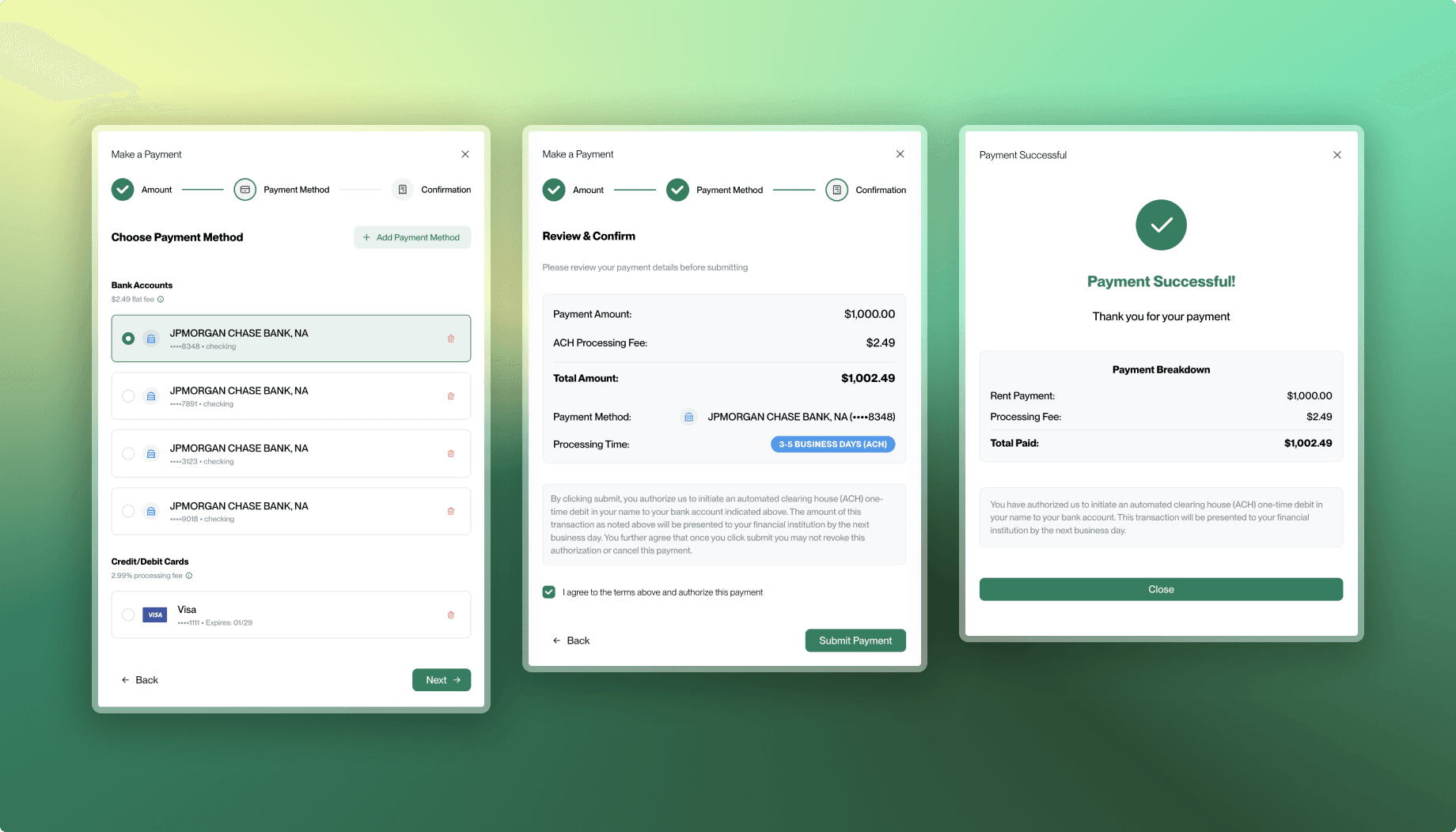
Today, TripleZip’s ledger tracks tenants, property managers, and payments, and the team rests easy on TigerBeetle’s extreme engineering, strict consistency, and reliability guarantees.
“The biggest value is peace of mind,” says Grayson. “The number one thing that TigerBeetle means for us is confidence that the numbers are correct. We're never going to lose data on someone's transaction because it's been posted across different regions with redundancy and it's so well tested. When someone goes to make a payment, we know our ledger will be up.”
With solid technical foundations in place, TripleZip’s next challenge is growth—selling software to small landlords across the United States. From lifelong friends to YC founders, through pivot to successful product launch, the future is bright.

Industry
Commercial Real Estate
Use
Ledger
Needs
Simplicity; Ease of Implementation
Country
United States
TPS
10+
Timeline
Two months from first contact to processing payments. Of the 3 month implementation of the financial stack, TigerBeetle took 1-2 days.
Benefits
Time to Market; Correctness
